What Is a Patella Band? How It Works, Fits and Supports Movement
A patella band is a narrow, adjustable knee support worn directly below the kneecap. It applies focused pressure across the patellar tendon while leaving most
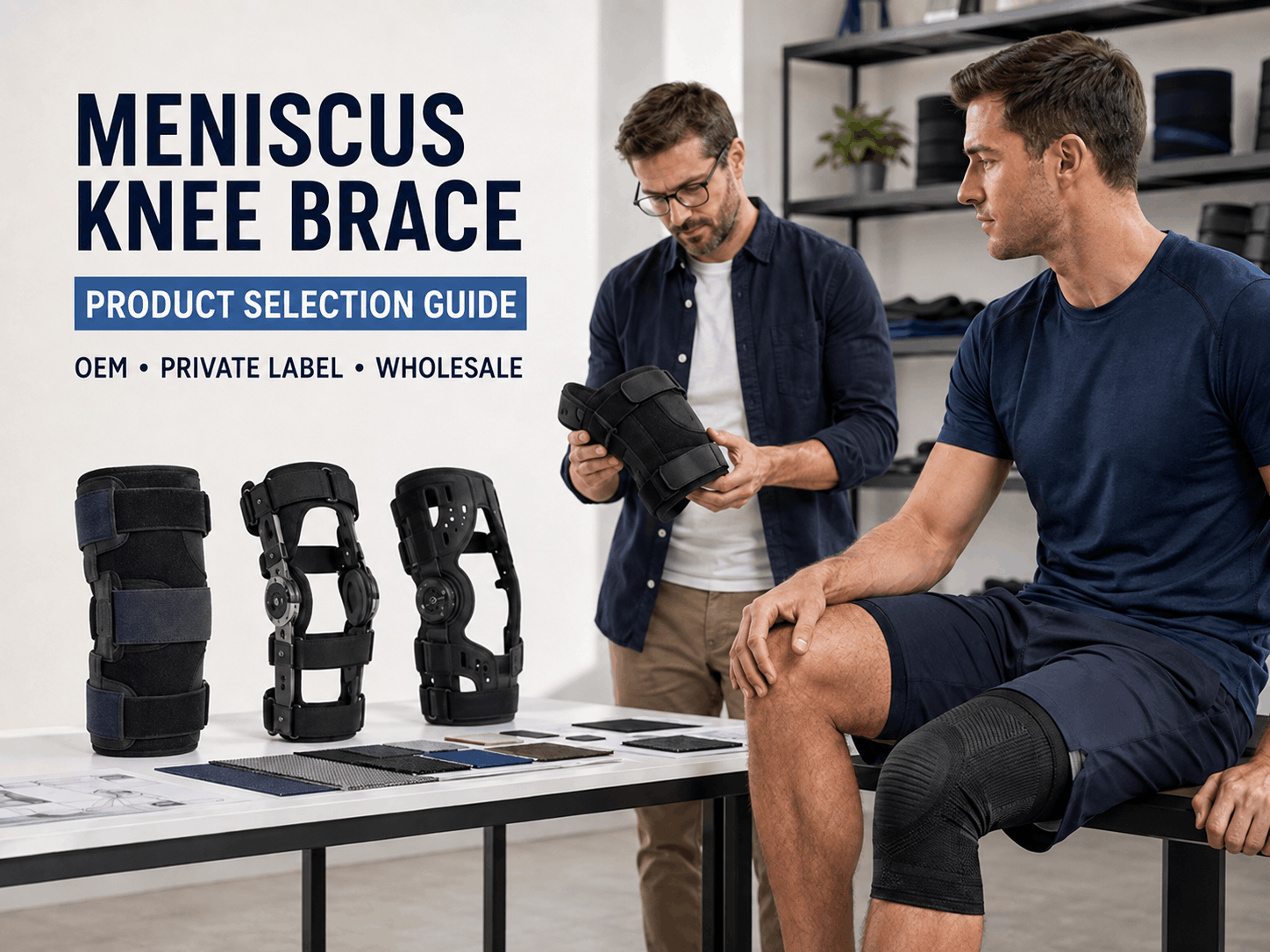
For a consumer, choosing a knee brace often starts with pain, fit and support. For a brand owner, importer or distributor, the decision is more complex. The product must also match the target market, retail price, size range, durability expectations, packaging, claims and destination-market requirements.
So, what is the best knee brace for a torn meniscus?
There is no single best design for every user. A breathable compression sleeve can suit a broad everyday-support range. An adjustable brace with straps and flexible stays offers a stronger mid-level option. A hinged brace is more appropriate when a product line requires greater medial-lateral stability. Unloader braces belong in more specialized channels and demand closer attention to fitting, intended use and regulatory positioning.
This guide helps B2B buyers select the right product architecture before starting private-label or OEM development.
For most retail assortments, begin with a three-level range: a compression sleeve for light everyday support, an adjustable stabilizer brace for moderate support, and a hinged brace for higher stability. Add an unloader model only when your market and sales channel can support its more specialized fitting and compliance needs.
The menisci are two pieces of fibrocartilage that help absorb shock, transmit load and contribute to knee stability. Meniscus injuries may be associated with pain, swelling, catching or locking, a giving-way sensation and reduced range of motion, according to the American Academy of Orthopaedic Surgeons.
A knee brace does not repair torn cartilage. Its role is supportive: depending on the construction, it may provide compression, improve the wearer’s sense of stability or limit unwanted movement. The NHS guidance on meniscus tears includes a knee support among measures that may help ease symptoms, while also advising users to seek medical help when symptoms are severe or persistent.
For B2B buyers, this distinction matters. Product copy should describe support functions accurately and avoid unsubstantiated promises such as “heals a meniscus tear,” “guarantees pain relief” or “speeds recovery.”
| Product type | Typical support level | Suitable commercial channels | Key sourcing priorities | Assortment role |
|---|---|---|---|---|
| Knitted compression sleeve | Light | Sports retail, e-commerce, wellness and general retail | Compression consistency, breathability, elastic recovery, anti-slip performance and accurate grading | Accessible, high-volume entry product |
| Wraparound brace with straps or flexible stays | Moderate | Sports stores, pharmacy retail, workwear and rehabilitation retail | Strap placement, hook-and-loop durability, stay retention, edge comfort and fit adjustability | Mid-tier upgrade with a wider fit range |
| Hinged knee brace | Moderate to high | Specialist sports, orthopedic and rehabilitation channels | Hinge alignment, bilateral stability, reinforced stitching, range of motion and component durability | Premium stability product |
| Unloader knee brace | Specialized | Clinical, orthopedic and medical-supply channels | Right/left configuration, compartment-specific design, fitting instructions, component testing and regulatory review | Higher-value specialist product |
Compression sleeves are usually the easiest products to launch because they are lightweight, familiar to consumers and suitable for a wide range of retail channels. They can be developed with breathable elastic knits, zoned compression, silicone anti-slip bands and open- or closed-patella designs.
For buyers, the main risk is inconsistent sizing. A sleeve that feels supportive in one size but loose or restrictive in another can generate poor reviews and returns. Do not approve only the logo and color. Approve the circumference, length, stretch recovery and fit of every size in the range.
A wraparound construction gives users more control over fit and compression. This makes it useful for brands serving broader leg shapes or customers who prefer an easier on-and-off design.
During development, check whether the straps create excessive bulk behind the knee, whether the edges curl after repeated use and whether the hook-and-loop areas maintain their hold after agreed cycle testing. Flexible side stays should remain correctly positioned and should not press into the skin during bending.
Hinged braces add medial-lateral support while allowing controlled flexion and extension. They can support a higher retail price, but they also introduce more quality-control points than a soft sleeve.
Buyers should inspect hinge symmetry, movement, noise, corrosion resistance, pocket reinforcement and stitching around high-stress areas. The hinge position must align correctly across the size range; simply enlarging one sample proportionally is not enough.
Unloader braces are designed to redistribute load away from a selected knee compartment. They are more specialized than general compression or stabilizer products and often require right/left versions, precise fitting and clear instructions.
This category can be commercially attractive for specialist channels, but it should not be treated as a simple logo-customization project. The intended use, performance evidence, labeling and destination-market requirements should be reviewed before launch.
An Amazon fitness brand, pharmacy distributor, rehabilitation supplier and sports club may all use the phrase “knee brace,” but they do not need the same product.
Broad e-commerce or sports retail: prioritize comfort, simple sizing, visual differentiation and lower return risk.
Workwear or all-day support: prioritize breathability, edge comfort, secure anti-slip performance and wash durability.
Rehabilitation or specialist retail: prioritize adjustable fit, higher stability, clear instructions and stronger documentation.
Medical-supply channels: confirm the intended purpose, claims, registration responsibilities and applicable market requirements before production.
Terms such as “maximum support” and “medical grade” are often used inconsistently. Replace vague language with a defined construction brief. Specify whether the product uses compression only, adjustable straps, spring stays, rigid stays, polycentric hinges or an unloading mechanism.
The open- or closed-patella choice should also be based on the intended user experience and product architecture—not used alone as proof of a higher support level.
Sizing is one of the biggest drivers of customer complaints in knee supports. A useful OEM brief should include:
Measurement position above, at or below the knee
Finished product length and circumference by size
Target stretch or compression range
Thigh-to-calf proportion
Size overlap between adjacent sizes
Target users, including unisex, plus-size or youth ranges
Approve the size chart together with the physical sample. If possible, conduct fit checks on several leg shapes instead of relying on a single model.
Common options include elastic knitted fabrics for breathable everyday compression and neoprene constructions for warmth, cushioning and stronger structure. Buyers may also request moisture-management yarns, soft-touch liners, latex-free material declarations or specific color and restricted-substance requirements.
The material decision should balance support, comfort, odor management, wash performance, cost and destination climate. A warm neoprene model may work well for strength training but may be less suitable for all-day wear in a hot market.
A visually attractive sample is not enough. Before bulk production, agree on a measurable specification and inspection plan covering:
Finished dimensions and size tolerances
Fabric weight, composition and color consistency
Stretch recovery or agreed compression performance
Seam strength, edge finishing and bar-tacked stress points
Hook-and-loop peel performance after repeated opening
Strap position and usable adjustment range
Stay or hinge alignment, retention and cycle performance
Anti-slip grip after movement and perspiration exposure
Wash appearance, print or logo durability and colorfastness
Correct labels, instructions, warnings, barcodes and packaging
The approved sample should become the reference standard for production. For repeat orders, retain the specification sheet, color standard, approved packaging file and inspection criteria to reduce batch-to-batch variation.
Instead of launching several similar knee sleeves, give each SKU a clear commercial role:
Good — Everyday Compression Sleeve: breathable knit, simple sizing and discreet support for broad retail demand.
Better — Adjustable Stabilizer Brace: straps and flexible stays for customers seeking a more secure, customizable fit.
Best — Hinged Support Brace: reinforced construction and higher stability for specialist or premium channels.
This structure makes comparison easier for distributors and end users, supports upselling and prevents products from competing against one another. An unloader brace can be added later as a separate specialist category if the channel and compliance plan justify it.
For a consumer-facing comparison of knee straps, tape and braces, buyers can also review our guide: Knee Strap, Knee Tape, or Brace?
A meniscus-support knee brace can be differentiated through more than a printed logo. Depending on the construction, B2B customization may include:
Knitted, neoprene or laminated material systems
Open- or closed-patella construction
Compression zones, straps, stays, hinges or silicone pads
Custom size grading from XS to extended sizes
Pantone-matched colors
Jacquard, heat-transfer, silicone-print or TPU branding
Custom care labels, instruction leaflets, retail boxes and barcodes
Multipacks or product-line packaging for distributors
See ProBalanceSport’s custom knee sleeves and supports and OEM/ODM development options for available product routes.
Product classification can depend on the intended purpose and the claims used on the product, packaging and marketing materials. In the United States, the FDA database lists an external knee brace for medical purposes under product code ITQ as a Class I device that is 510(k)-exempt; this does not mean every regulatory obligation is automatically removed. The exact product, establishment roles, labeling and applicable requirements still need to be verified. See the FDA product classification entry for external knee braces.
For the European Union, the intended purpose is central to the application of the EU Medical Device Regulation. Buyers should define the intended market and claims before finalizing packaging or commissioning tests.
This is why compliance should be discussed at the beginning of an OEM project—not after the product and packaging have already been produced. Always obtain product-specific advice from a qualified regulatory professional for the destination market.
To receive a useful recommendation and accurate quotation, send the supplier:
Destination country and sales channel
Target user and intended support level
Reference image, drawing or existing sample
Preferred material and key structural features
Size range and estimated quantity by size
Logo method, colors and packaging requirements
Required documents or third-party tests
Target delivery date and destination
If some specifications are unknown, state the commercial goal—for example, “a breathable mid-support brace for pharmacy retail at a target price”—and ask the supplier to recommend one or two suitable constructions before sampling.
ProBalanceSport is a China-based product development and sourcing partner for international B2B buyers. We coordinate private-label, semi-custom and full-custom knee-support projects through a specialized manufacturing network.
For many standard private-label models, our published starting MOQ is 500 units. Typical sample development is approximately 5–7 days, with bulk production commonly taking 15–25 days after sample and specification approval. Timing and MOQ depend on the construction, components, packaging and final order plan.
Our project support can include:
Product structure and material recommendations
Logo, sizing and retail-packaging development
Sample coordination and specification confirmation
Production follow-up and quality coordination
Third-party testing coordination based on the buyer’s target market
Export and delivery support
Send us your target market, sales channel, estimated quantity, preferred support level, branding requirements and launch timeline. We will help identify the most suitable product route before preparing the quotation.
Email: info@probalancesport.com
WhatsApp: +86 135 1171 8562
Product category: Custom Knee Sleeves & Supports
For broad retail demand, a compression sleeve is usually the simplest entry product. An adjustable brace with stays creates a stronger mid-tier offer, while a hinged brace can serve premium or specialist channels. The right choice depends on the target user, support level, retail price and compliance plan.
ProBalanceSport’s published starting MOQ for many standard private-label knee supports is 500 units. The MOQ may change for custom knitting, special colors, molded components, hinges, packaging or multiple sizes. Send the full product brief for confirmation.
Typical sample development is approximately 5–7 days after the specifications are confirmed. Bulk production is commonly 15–25 days after sample approval. Custom components, testing, packaging and peak-season capacity may affect the schedule.
Yes. Available options can include custom colors, size grading, jacquard logos, heat-transfer graphics, silicone prints, TPU badges, care labels, instruction leaflets, retail boxes and barcodes.
Do not use treatment or healing claims without appropriate evidence and a destination-market regulatory review. Safer functional wording may describe compression, support, adjustability or stability, but every claim should still match the product’s intended purpose and supporting documentation.
Provide the destination market, sales channel, preferred construction, material, size range, quantity, logo, packaging, required documentation and delivery target. A reference photo or sample can shorten the development process.
Medical and regulatory disclaimer: This article is for general product-selection and sourcing information. It does not provide medical advice, diagnosis, treatment recommendations or legal/regulatory advice. End users should follow guidance from qualified healthcare professionals, and B2B buyers should confirm all destination-market requirements for their exact product and claims.

Hi, I’m Jack Wang (the CEO of Natiprol Lianyungang Corporationh), hope you like this article.
With more than 20 years of experience in sports support industry since 2008, I’d love to share with you the valuable knowledge from a Chinese supplier’s perspective.
I am looking forward to talking with you about your ideas and thoughts.
A patella band is a narrow, adjustable knee support worn directly below the kneecap. It applies focused pressure across the patellar tendon while leaving most
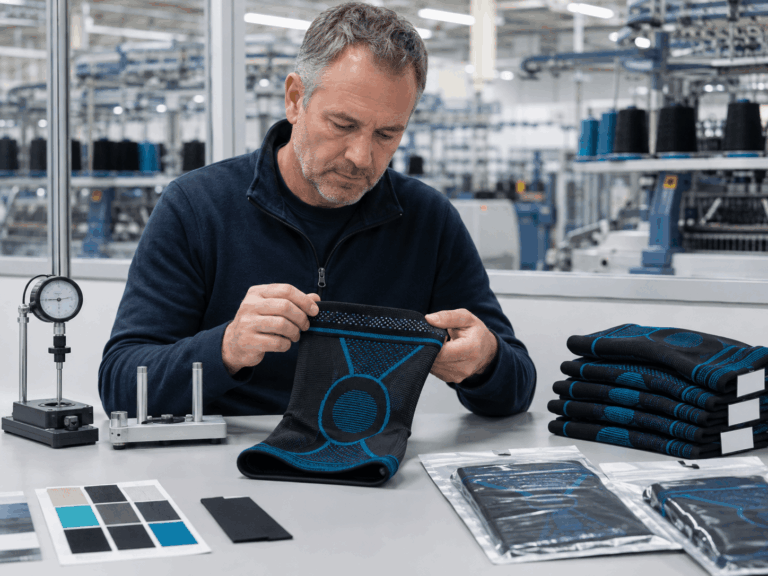
Quick answer A reliable knee support quality plan should control the approved sample, materials, measurements, compression feel, seams, anti-slip elements, straps or stabilizers, labeling and
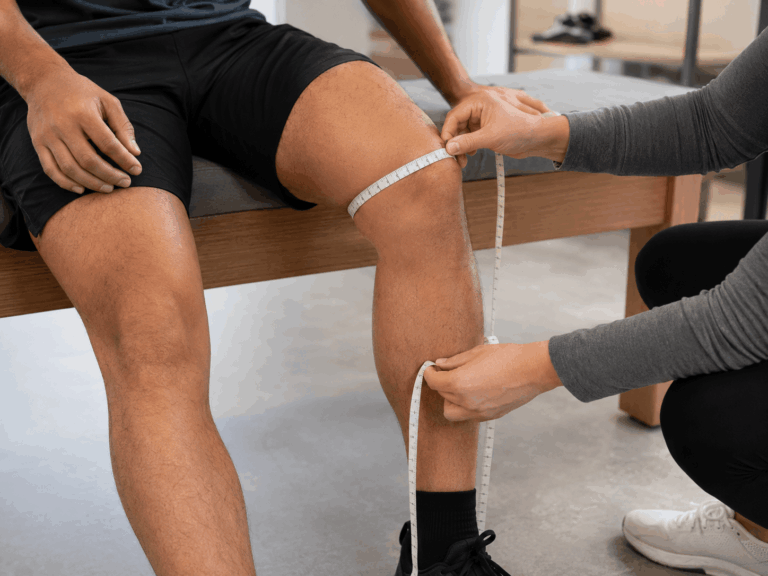
Why sizing is a commercial problem, not just a technical detail Fit affects product reviews, support tickets, return costs and repeat purchases. If a sleeve
Factory-direct · NDA friendly · Sample support · OEKO-TEX/BSCI (on request)

Start a Conversation
Hi! Click one of our member below to chat on WhatsApp
Hey, how can I help you today?